


1/24/2026, 04:48:23
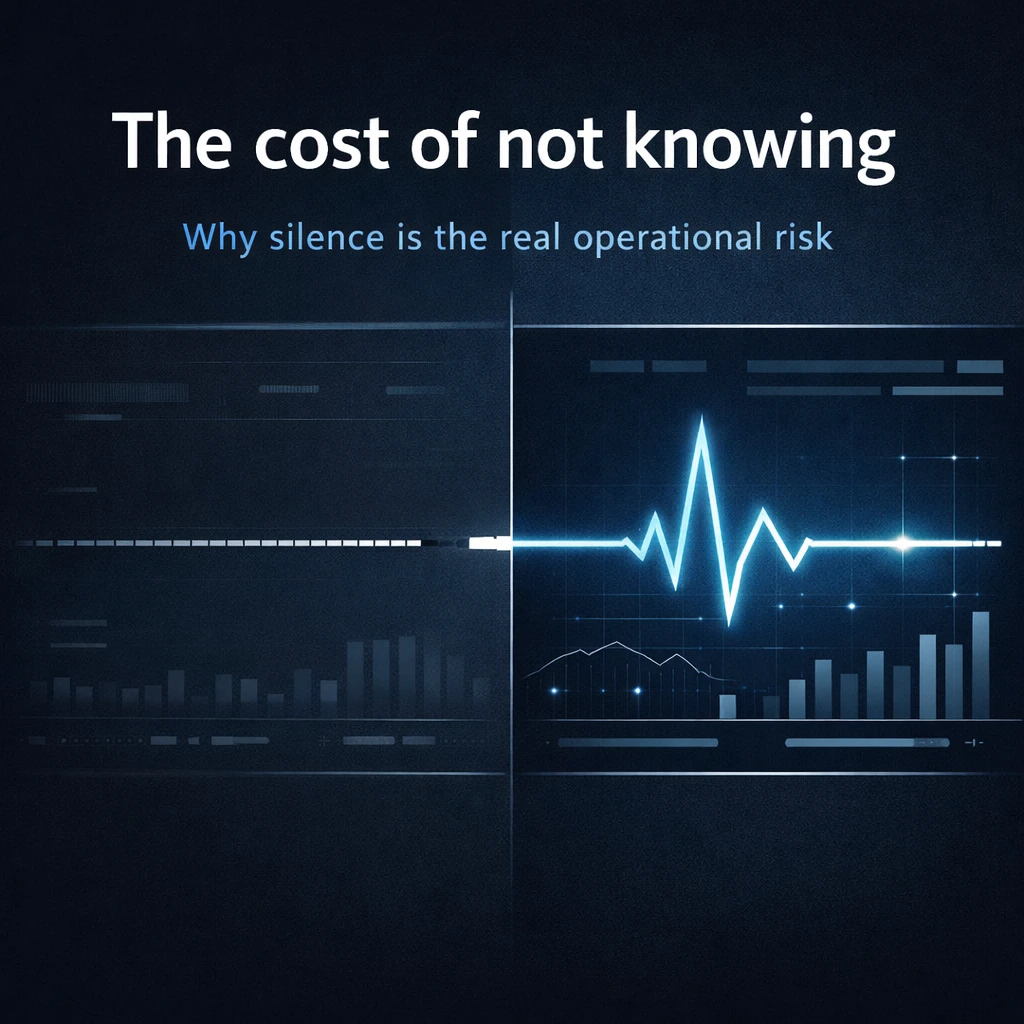
The Cost of Not Knowing: Why Silence Is the Real Operational Risk
Introduction: The Risk Nobody Budgets For
Most operational failures don’t announce themselves.
There is no alarm.
No error message.
No clear moment when “something broke.”
What happens instead is quieter — and far more dangerous.
A small change goes unnoticed.
A signal stops arriving.
A process degrades slowly enough that it feels normal.
And because nothing complains, everyone assumes everything is fine.
This is how modern systems fail: not loudly, but politely.
In digital operations — websites, SaaS platforms, online businesses — silence is often interpreted as stability. If uptime checks are green, dashboards look calm, and no alerts are firing, the system appears healthy. Teams move on. Attention shifts elsewhere. Confidence grows.
But silence does not mean safety.
It only means nothing is speaking.
And systems that don’t speak can drift a very long way before anyone notices.
The real operational risk today isn’t downtime.
Downtime is obvious.
Downtime triggers response.
Downtime forces attention.
The real risk is delayed awareness — the growing gap between when something starts going wrong and when you become aware of it.
That gap is where trust erodes.
That gap is where revenue leaks quietly.
That gap is where search rankings slip, conversions soften, and security assumptions decay.
And by the time the issue becomes visible, the most expensive part has already happened.
What makes this risk especially dangerous is that it doesn’t feel like risk at all.
There’s no urgency in silence.
No stress signal.
No reason to act.
Silence creates a false sense of operational maturity — the feeling that “we have things under control” simply because nothing is demanding attention.
In reality, it often means the opposite:
you don’t yet know what deserves your attention.
This is not a failure of tooling alone.
Most teams today already have:
- monitoring dashboards
- uptime checks
- analytics
- logs
- alerts
Yet incidents still go unnoticed for days or weeks.
Customers notice before operators do.
Search engines react before teams investigate.
The issue is not lack of data — it’s lack of meaningful signals.
Modern systems don’t fail because they are too complex.
They fail because change becomes invisible.
A website can be “up” while:
- performance slowly degrades
- layouts break only on certain devices
- integrations fail silently
- security assumptions drift out of date
None of these trigger classic alarms.
All of them have real business impact.
Silence masks them until the cost compounds.
This article explores why not knowing is one of the most underestimated operational costs — and why silence, not chaos, is the real risk in modern digital systems.
We’ll look at:
- how silence creates false confidence
- why dashboards don’t protect against blind spots
- how operational risk is temporal, not binary
- and why observability is less about “seeing everything” and more about not missing what matters
Because the question is not whether something will go wrong.
The question is whether you’ll know early —
or only when the silence finally breaks.
1. Silence Feels Like Stability (But Isn’t)
Silence is reassuring.
No alerts.
No warnings.
No red numbers demanding attention.
In day-to-day operations, silence quickly becomes synonymous with normal. Teams get used to it. They trust it. Over time, they even depend on it as proof that everything is under control.
But this is a dangerous shortcut.
Silence does not describe the state of a system.
It only describes the absence of signals.
And those are not the same thing.
The Quiet Trap of “Nothing Happened”
Most operational assumptions are built on a simple, unspoken rule:
If something important breaks, we’ll know.
This feels reasonable. After all:
- uptime monitors will fire
- error logs will fill up
- customers will complain
- something will make noise
Except… many failures don’t.
They degrade.
They stall.
They partially fail.
They fail only under certain conditions.
And none of that necessarily triggers alarms.
When Silence Becomes a Design Flaw
Over time, silence turns from a neutral state into an implicit signal:
- no alerts → things must be fine
- no emails → nothing to check
- no complaints → users are happy
This is how silence starts replacing verification.
Instead of asking “What is the system actually doing?”, teams ask “Did anything complain?”
If the answer is no, attention moves elsewhere.
The Problem With “Green”
Green dashboards are especially deceptive.
A system can be “green” while:
- response times slowly creep up week over week
- a critical integration stops firing events
- a background job runs but no longer completes
- a checkout flow works for most users — but not all
- a plugin update partially applies and leaves files in an inconsistent state
Green doesn’t mean healthy.
It means nothing crossed a predefined threshold.
And thresholds are always late.
Silence Normalizes Drift
One of the most dangerous properties of silence is that it normalizes gradual change.
When something breaks suddenly, it feels wrong.
When something degrades slowly, it becomes the new normal.
A 5% slowdown feels negligible.
Until it becomes 20%.
Until conversion drops.
Until SEO rankings slip.
By then, silence has already done its damage.
Why Humans Trust Silence
Silence is attractive because it reduces cognitive load.
No signals means:
- fewer decisions
- fewer interruptions
- less perceived risk
In busy environments, silence feels like relief.
But operational safety doesn’t come from fewer signals — it comes from better ones.
Silence doesn’t mean “nothing is wrong.”
It means “we don’t currently know what’s wrong.”
Those are radically different states.
Stability Is an Actively Maintained Condition
Real stability is not passive.
It is not the absence of alerts.
It is not the lack of incidents.
It is not a calm dashboard.
Stability is the result of:
- continuous awareness
- early detection of change
- understanding what should be happening
- noticing when that expectation is violated
Silence provides none of that by default.
The Dangerous Equation
Most systems quietly operate under this assumption:
No alerts = No issues
In reality, the more accurate equation is:
No alerts = No defined signal was triggered
And that gap — between reality and what you’ve defined — is where operational risk hides.
Silence feels like stability because it asks nothing of you.
But systems don’t stay healthy by being ignored.
They stay healthy by being understood.
2. The Hidden Cost Curve of Not Knowing
Most teams can estimate the cost of a failure.
Downtime has a price.
A breach has a price.
A missed order has a price.
What’s much harder to quantify is the cost of not knowing — because it doesn’t appear as a single event.
It appears as time.
Cost Doesn’t Arrive All at Once
When something breaks loudly, the cost is immediate and visible.
But when something degrades silently, the cost spreads out:
- across days instead of minutes
- across multiple systems instead of one
- across perception, not just metrics
There is no invoice for silence.
No line item for delayed awareness.
No alert that says “you should have noticed this earlier.”
And yet, this is where most operational losses accumulate.
The Cost Curve Is Temporal
Silence creates a very specific kind of cost curve.
Not a spike —
a slope.
At first, nothing feels wrong.
Then something feels slightly off.
Then people adapt.
Then outcomes change.
And only later does someone ask:
“How long has this been happening?”
By the time that question is asked, the cost is no longer theoretical.
Early Silence Is Cheap — Late Silence Is Expensive
In the beginning, not knowing is almost free.
Nothing urgent breaks.
Nothing demands action.
Nothing interrupts your day.
This is why silence is tolerated.
But as time passes, not knowing compounds:
- assumptions solidify
- baselines drift
- explanations get rewritten to fit the new normal
What would have been trivial to fix early becomes:
- harder to diagnose
- harder to explain
- harder to reverse
The system didn’t suddenly fail.
It simply went unobserved for too long.
The Most Expensive Moment Is Awareness
Ironically, the most costly moment is often the moment you finally notice.
Because awareness collapses time.
Weeks or months of silent drift suddenly compress into:
- urgent investigations
- uncomfortable questions
- retroactive explanations
“Why didn’t we see this earlier?”
“Was this always like this?”
“Did users notice before we did?”
At that point, the cost is no longer just technical.
It’s reputational.
Psychological.
Organizational.
Silence Shifts Who Pays the Price
When you don’t know what’s happening, someone else does.
Users feel friction before you feel alerts.
Search engines react before you check reports.
Attackers probe before logs are reviewed.
Silence doesn’t eliminate cost —
it transfers it.
From systems to people.
From operators to customers.
From prevention to recovery.
Why This Cost Is Rarely Budgeted
No one allocates budget for:
- “unknown unknowns”
- “delayed realization”
- “false confidence”
Budgets are built around visible events.
Silence avoids those events — until it doesn’t.
And when it finally breaks, the response is always the same:
“We need better visibility.”
Which is another way of saying:
“We paid too much for not knowing.”
Not Knowing Is a Multiplier
The real danger of silence isn’t the initial issue.
It’s what silence amplifies:
- wrong decisions
- delayed reactions
- misplaced confidence
- misattributed causes
Silence doesn’t just hide problems.
It distorts reality.
And decisions made in distorted reality are almost always expensive.
The Cost Curve Never Shows Up on Dashboards
Dashboards show current state.
They don’t show:
- how long something was wrong before detection
- how many opportunities were missed
- how much trust quietly eroded
Those costs live in hindsight.
Which is why teams underestimate them — until they experience them.
The paradox of silence is this:
The longer you don’t know,
the more expensive knowing becomes.
And by the time silence breaks,
the cost has already been paid.
3. Why Dashboards Don’t Solve Silence
When teams sense blind spots, their instinctive response is simple:
“We need better dashboards.”
More charts.
More metrics.
More panels.
More tabs.
Visibility feels like progress.
But dashboards don’t eliminate silence — they often formalize it.
Dashboards Answer Questions You Already Know to Ask
Every dashboard is built around assumptions:
- what matters
- what can go wrong
- what thresholds define “bad”
That means dashboards are inherently reactive.
They tell you:
- Is this number above or below a line?
- Is this service responding right now?
- Did this predefined condition fire?
They do not tell you:
- what you didn’t think to measure
- what changed subtly but meaningfully
- what stopped happening altogether
Silence lives outside predefined questions.
More Data ≠ Earlier Understanding
Adding metrics feels like safety.
In practice, it often:
- increases noise
- fragments attention
- pushes responsibility onto the viewer
Now you are expected to notice:
- which chart looks different today
- which baseline quietly shifted
- which metric hasn’t updated in days
Silence doesn’t disappear — it just hides between graphs.
Dashboards Are Optimized for State, Not Change
Dashboards are excellent at answering:
“What is the system doing right now?”
They are poor at answering:
“How is the system behaving differently than before?”
Most operational risk doesn’t come from bad current states.
It comes from unexpected change over time.
Slow drift looks green.
Partial failure looks acceptable.
Degradation hides behind averages.
Dashboards are snapshots.
Silence accumulates in the timeline.
The Green Illusion
A fully green dashboard is psychologically powerful.
It signals:
- permission to ignore
- reassurance without verification
- a false sense of closure
Green tells you nothing is urgent — not that everything is healthy.
And once teams trust green, they stop asking deeper questions.
Silence wins.
Dashboards Can’t Detect Absence
One of the most dangerous failures is something that stops happening.
- a job that no longer runs
- a signal that no longer arrives
- a flow that no longer completes
Dashboards struggle with absence because:
- absence has no value
- nothing crosses a threshold
- nothing “fails” explicitly
Nothing breaks.
Nothing turns red.
Nothing alerts you.
And yet, something is fundamentally wrong.
Dashboards Shift Responsibility to Humans
A dashboard assumes:
Someone will look at this and notice.
But humans:
- skim
- habituate
- miss slow changes
- avoid cognitive overload
Silence thrives in environments where attention is assumed but not enforced.
Dashboards don’t observe.
People do.
And people are not reliable anomaly detectors.
When Dashboards Become Ritual, Not Insight
Over time, dashboards turn into:
- background wallpaper
- routine checkboxes
- something you glance at “just in case”
They become symbols of control rather than sources of understanding.
Silence becomes institutionalized.
“We have dashboards, so we should have seen it.”
But dashboards don’t see.
They display.
Visibility Without Interpretation Is Still Blindness
Seeing data is not the same as understanding behavior.
Dashboards show:
- metrics
- numbers
- states
They don’t explain:
- why something matters
- what changed relative to expectations
- what deserves attention now
Without interpretation, visibility is just organized silence.
Dashboards are not useless.
But they solve a different problem.
They help you confirm what you’re already watching —
not discover what you didn’t realize was missing.
Silence doesn’t come from lack of data.
It comes from lack of signals that speak when reality changes.
4. Operational Risk Is Temporal, Not Binary
Most operational thinking is binary.
Up or down.
Working or broken.
Secure or compromised.
This framing is comforting because it’s simple.
It’s also dangerously incomplete.
Real operational risk doesn’t live in states.
It lives in time.
Failure Is Rarely Instant
Systems almost never jump from healthy to broken in a single moment.
What actually happens is slower:
- small inconsistencies appear
- performance drifts
- assumptions stop matching reality
- edge cases become common cases
None of this looks like failure — yet.
Binary thinking misses this entire phase.
The Question Binary Thinking Can’t Answer
Binary monitoring asks:
“Is the system down?”
Temporal risk asks:
“How long has this been drifting without notice?”
That single question changes everything.
Because duration turns small issues into serious ones.
A misconfiguration for five minutes is noise.
The same misconfiguration for five weeks is strategy-level failure.
Time Is the Real Amplifier
Most operational problems are survivable in isolation.
What makes them expensive is how long they exist unobserved.
Time amplifies:
- impact
- confusion
- recovery effort
- downstream effects
The longer an issue lives in silence, the harder it is to:
- identify its origin
- explain its consequences
- separate cause from coincidence
By the time you notice, the timeline is already polluted.
“It Was Always Like That” Is a Red Flag
One of the most dangerous phrases in operations is:
“I think it’s always been like this.”
This usually means:
- no baseline was preserved
- no change was noticed
- no one knows when it started
Silence erases history.
Without temporal awareness, teams lose the ability to reason about when reality changed — and why.
Binary Alerts Trigger Too Late
Threshold-based alerts are, by design, delayed.
They fire when:
- something crosses a hard limit
- damage is already visible
- users are already affected
They don’t alert on:
- unusual calm
- stalled processes
- slow but steady degradation
Binary alerts protect against catastrophe.
They do not protect against erosion.
Risk Accumulates Between Checks
When monitoring is binary, risk accumulates quietly between events.
Each check answers:
“Is it broken right now?”
It does not answer:
“What happened since the last time we looked?”
That gap is where:
- problems incubate
- assumptions age
- surprises are born
Time doesn’t stop between checks.
Risk shouldn’t be invisible there.
Operational Maturity Is About Time Awareness
Mature systems don’t just know what is happening.
They know:
- when it started
- how it evolved
- whether it’s accelerating or stabilizing
- how it compares to past behavior
This requires a shift:
from state-based thinking
to timeline-based understanding.
Silence Breaks the Timeline
When nothing speaks, the timeline fragments.
Events lose context.
Changes lose meaning.
Decisions lose grounding.
Silence doesn’t just hide problems —
it destroys the narrative that would have made them understandable.
Binary systems ask:
“Is everything okay?”
Temporal systems ask:
“How is reality changing?”
Only one of those questions reveals risk early enough to matter.
Key Takeaways So Far
- Silence is not a neutral state — it actively hides change
- Most operational risk accumulates over time, not in single events
- Binary “up/down” thinking detects failure late, not early
- Dashboards show current state, but miss slow drift and absence
- The longer something goes unnoticed, the more expensive it becomes
- Real stability depends on temporal awareness, not calm dashboards
5. Silence Creates False Confidence
Silence doesn’t just hide problems.
It reshapes how people think.
When nothing demands attention, confidence grows — not because reality is stable, but because uncertainty is invisible.
This is how silence turns into belief.
Confidence Without Evidence
In quiet systems, confidence is often inferred, not earned.
No alerts become proof.
No incidents become validation.
No complaints become reassurance.
Over time, this creates a subtle but powerful assumption:
If something important were wrong, we would know.
That belief replaces verification.
Calm Is Mistaken for Control
Silence feels like calm.
Calm feels like control.
But control without awareness is fragile.
True control requires:
- feedback
- confirmation
- continuous adjustment
Silence removes feedback, but preserves the feeling of control.
This is why false confidence is so dangerous — it feels indistinguishable from real stability.
Silence Discourages Curiosity
When systems are noisy, people investigate.
When systems are quiet, people stop asking questions.
- checks become less frequent
- assumptions go unchallenged
- “good enough” becomes the standard
Silence trains teams to not look.
And what you don’t look at, you don’t improve.
The Comfort Trap
Silence reduces cognitive load.
No interruptions.
No decisions.
No urgent trade-offs.
In busy environments, this is deeply attractive.
But comfort is not safety.
Silence optimizes for short-term ease at the expense of long-term understanding.
False Confidence Becomes Cultural
Over time, silence doesn’t just affect individuals — it shapes culture.
Teams begin to:
- equate fewer alerts with maturity
- view investigation as unnecessary pessimism
- delay instrumentation because “nothing is broken”
Eventually, questioning the calm feels disruptive.
Silence becomes a norm.
When Confidence Outruns Reality
The real danger appears when confidence grows faster than understanding.
Decisions get made on assumptions:
- “This flow is stable.”
- “That integration has been fine for months.”
- “We would have noticed if it wasn’t.”
These statements feel rational — until reality contradicts them.
And when it does, the gap between belief and truth is painful.
Silence Delays Learning
Every unnoticed issue is a missed lesson.
Without signals:
- causes remain unknown
- patterns go unrecognized
- prevention never happens
Silence doesn’t just delay response —
it delays learning.
And organizations that don’t learn repeat the same failures with higher stakes.
Confidence Should Be Earned, Not Assumed
Healthy confidence comes from:
- evidence
- feedback loops
- clear understanding of system behavior
Silence provides none of these.
It only provides relief.
And relief is not reliability.
False confidence is one of the most expensive side effects of silence.
Because when something finally breaks, the question is never:
“What happened?”
It’s:
“Why were we so sure everything was fine?”
6. What Actually Breaks in Silence
When people imagine failure, they imagine collapse.
Something stops working.
Something goes offline.
Something clearly breaks.
But silence doesn’t favor dramatic failure.
It favors partial failure.
And partial failure is far more dangerous.
Silence Breeds Incomplete Breakage
In quiet systems, things rarely stop outright.
They continue — just not fully, not reliably, not correctly.
A process runs, but produces less.
A flow completes, but not for everyone.
A signal fires, but without meaning.
Because nothing fully fails, nothing demands attention.
The system is technically “working.”
Operationally, it isn’t.
The Most Common Silent Failure: “Almost”
Almost correct.
Almost reliable.
Almost healthy.
Silence allows systems to exist in this gray zone indefinitely.
Nothing screams.
Nothing collapses.
Nothing forces a decision.
So the system stays almost — quietly leaking value.
Partial Failures Are Hard to Notice by Design
Partial failures hide because they:
- don’t violate hard thresholds
- don’t affect all users
- don’t produce obvious errors
- don’t happen consistently
They show up as:
- anomalies instead of incidents
- edge cases instead of outages
- friction instead of failure
Silence protects them.
Absence Is the Most Invisible Failure Mode
One of the most dangerous things that can happen is that something stops happening.
No crash.
No error.
No alert.
Just… absence.
Absence doesn’t announce itself.
It has no shape.
No metric spikes.
No color change.
Without explicit expectations, absence looks exactly like normal.
Silence Breaks Cause-and-Effect
When failures remain unnoticed, timelines blur.
By the time someone investigates:
- multiple changes have occurred
- correlations are lost
- causes are speculative
Silence turns diagnosis into archaeology.
You’re no longer asking what happened.
You’re guessing what might have happened.
Silent Failures Spread Sideways
Because they don’t stop the system, silent failures propagate.
People build on top of broken assumptions.
Workarounds become permanent.
New features adapt to degraded behavior.
Eventually, the failure isn’t an anomaly anymore.
It’s infrastructure.
And fixing it now means undoing layers of adaptation.
The Cost Isn’t the Bug — It’s the Normalization
The most expensive part of silent failure isn’t the initial issue.
It’s the moment it becomes accepted.
Once teams adjust behavior around it, the failure:
- stops being questioned
- stops being investigated
- stops being fixable without disruption
Silence doesn’t just hide problems.
It teaches people to live with them.
Loud Failures Get Fixed. Silent Ones Get Embedded.
When something breaks loudly:
- it gets priority
- it gets resources
- it gets resolved
When something breaks quietly:
- it becomes background
- it becomes tolerated
- it becomes part of the system
Silence determines what gets fixed — and what becomes permanent.
Silent failures don’t feel urgent.
They feel ignorable.
And that’s exactly why they’re so costly.
7. Observability Is About Detecting the Absence of Signals
Most monitoring systems are designed to notice events.
Something fails.
Something spikes.
Something crosses a threshold.
But silence isn’t an event.
And that’s why traditional monitoring struggles with it.
The Hardest Thing to Detect Is “Nothing”
A server going down is visible.
An error rate jumping is visible.
But how do you notice:
- a signal that stopped arriving
- a process that still runs but no longer produces outcomes
- a pattern that quietly disappears
Nothing happened — and that’s the problem.
Absence has no shape.
It doesn’t break rules.
It doesn’t violate thresholds.
Without expectations, absence looks exactly like stability.
Observability Starts With Expectations
You can’t detect absence unless you know what should be present.
Observability is built on questions like:
- What normally happens here?
- How often should this change?
- What behavior would be surprising?
Silence becomes meaningful only when there is a baseline to compare against.
Without that, silence is just emptiness.
Silence Becomes a Signal When Context Exists
In an observable system, silence is no longer neutral.
It is interpreted.
A missing heartbeat means something stalled.
A flat metric where variation is expected means something froze.
An unchanged pattern means the system stopped responding to reality.
Silence stops being “nothing” and becomes information.
This Is Why More Data Doesn’t Help
Adding more metrics doesn’t solve the problem of absence.
You can have:
- thousands of data points
- endless dashboards
- real-time streams
And still miss the most important thing:
What stopped happening?
Observability is not about collecting everything.
It’s about understanding change — including missing change.
Listening for Quiet Is a Different Skill
Traditional monitoring listens for noise.
Observability listens for:
- irregular calm
- broken rhythms
- stalled feedback loops
It’s closer to noticing when a heartbeat is too steady than when it spikes.
Silence becomes suspicious when behavior is expected to vary.
Absence Reveals System Health
Healthy systems are alive.
They fluctuate.
They respond.
They change.
Perfect flatness is often a warning sign — not a success.
Observability recognizes that:
- variability is normal
- responsiveness is healthy
- total calm is rare
When everything stops changing, something is wrong.
Signals Should Explain, Not Just Alert
Observability isn’t just about detection.
It’s about interpretation.
Instead of:
“Something failed.”
You want:
“This behavior deviated from its normal pattern, and here’s why it matters.”
Silence alone isn’t actionable.
Context makes it meaningful.
From Monitoring Events to Understanding Behavior
Monitoring answers:
“Did an event occur?”
Observability asks:
“Is the system behaving the way it should over time?”
That shift is what turns silence into insight.
Observability doesn’t make systems louder.
It makes them more honest.
It gives silence a voice —
and turns missing signals into early warnings instead of late surprises.
Key Takeaways: Observability & Silence
- Silence is not empty — it’s unexamined behavior
- The hardest failures to detect are missing signals, not noisy ones
- Absence only becomes visible when expectations exist
- More metrics don’t solve silence; context does
- Healthy systems change — perfect calm is often a warning
- Observability turns silence from a blind spot into information
8. The Psychological Cost: Living in Reactive Mode
Silence doesn’t just affect systems.
It affects people.
When awareness is delayed, teams don’t work in calm — they work in anticipation of surprise. Even when everything appears stable, there’s an underlying tension: the sense that something could be wrong, and you wouldn’t know until it’s urgent.
That tension shapes behavior.
Reactivity Is Born From Late Awareness
When problems are discovered late, response is rushed.
Investigation happens under pressure.
Decisions are made with incomplete context.
Fixes prioritize speed over understanding.
Over time, teams learn that issues arrive as emergencies — never as early signals.
So they stop expecting early warnings.
Silence Trains Firefighting
In quiet systems, work clusters around incidents.
Long stretches of calm are followed by:
- sudden urgency
- context switching
- emotional load
- blame-oriented retrospectives
This rhythm teaches teams that:
- stability is temporary
- calm is suspicious
- problems always arrive unannounced
Firefighting becomes the default mode.
Cognitive Load Accumulates Invisibly
Living reactively is mentally expensive.
People spend energy on:
- second-guessing systems
- manually checking “just in case”
- replaying past incidents
- worrying about what they might be missing
Even in calm periods, attention is fragmented.
Silence doesn’t reduce cognitive load —
it moves it into the background, where it constantly drains energy.
Late Signals Erode Confidence
Each surprise incident chips away at trust:
- trust in tools
- trust in processes
- trust in one’s own judgment
Teams begin to feel:
- less proactive
- more defensive
- more hesitant to make changes
Confidence erodes not because people fail —
but because they’re always reacting after the fact.
Learning Suffers in Reactive Environments
When everything is urgent, nothing is understood deeply.
Root causes are skipped.
Patterns go unrecognized.
Prevention feels like a luxury.
Teams fix symptoms because there’s no time to ask why silence existed in the first place.
Calm Should Reduce Stress — Not Increase It
True calm is grounded in awareness.
False calm is fragile.
When silence is the only signal, calm becomes unsettling — because it provides no reassurance that the system is actually healthy.
People relax less.
They check more.
They trust less.
Psychological Safety Depends on Predictability
Teams thrive when:
- signals arrive early
- issues are explainable
- surprises are rare
Silence does the opposite.
It makes work feel random.
And randomness is stressful — even when things appear “fine.”
Observability Restores Agency
When systems speak early and clearly:
- teams regain control
- stress drops
- confidence stabilizes
Problems become manageable conversations instead of emotional events.
People stop firefighting.
They start reasoning.
The psychological cost of silence is subtle, but cumulative.
It turns capable teams into reactive ones —
not because they lack skill,
but because they lack timely understanding.
9. The Real Question Isn’t “Will Something Break?”
At some point, every system breaks.
Not because it was poorly built.
Not because the team was careless.
But because change is constant, and assumptions age.
The idea that failure can be eliminated is comforting — and false.
The real question is not if something will break.
It’s when you’ll know.
Breakage Is Inevitable. Awareness Is Not.
Software changes.
Dependencies update.
Environments shift.
Usage patterns evolve.
Even the best systems drift.
What separates resilient operations from fragile ones isn’t the absence of failure — it’s early awareness.
Two Very Different Futures
Every issue has two possible timelines.
In one:
- the system notices early
- signals appear while the impact is small
- fixes are deliberate
- explanations are clear
In the other:
- silence persists
- users notice first
- pressure replaces reasoning
- the past becomes a blur
The technical issue might be identical.
The outcome never is.
Early Knowledge Changes Everything
When you know early:
- decisions are calmer
- options are broader
- trade-offs are explicit
When you know late:
- choices narrow
- mistakes compound
- explanations get defensive
The difference is not tooling sophistication.
It’s timing.
“Will We Know?” Is an Operational Design Choice
Early awareness doesn’t happen by accident.
It’s designed.
It depends on:
- what you expect to happen
- what you consider meaningful change
- what silence should mean
Asking “Will we know?” forces these decisions to the surface.
This Question Reveals Maturity
Immature operations ask:
“Is it working right now?”
Mature operations ask:
“Would we notice if it slowly stopped working?”
That single shift reframes:
- monitoring strategy
- alerting philosophy
- team confidence
And it exposes blind spots that dashboards never show.
Knowing Early Is a Form of Respect
Early awareness respects:
- users’ time
- teams’ energy
- organizations’ trust
It prevents situations where:
- customers report problems first
- search engines penalize before humans react
- teams explain surprises instead of preventing them
Knowing early isn’t just efficient.
It’s ethical.
The Question That Guides Everything
So the question to design around is simple:
If something important changed tomorrow — would we know before it mattered?
If the answer is uncertain, silence is already a risk.
10. From Silence to Quiet Assurance
The answer to silence is not noise.
More alerts don’t create clarity.
More dashboards don’t create confidence.
More data doesn’t create understanding.
What replaces silence is assurance — quiet, evidence-based assurance.
Quiet Assurance Is Not Constant Attention
Mature systems don’t demand focus.
They earn trust by:
- speaking only when something meaningfully changes
- providing context, not just alarms
- preserving history so change is understandable
Quiet assurance feels calm — but unlike silence, it is grounded in awareness.
Assurance Comes From Knowing What “Normal” Looks Like
You can’t trust a system unless you know how it behaves when it’s healthy.
Quiet assurance is built on:
- clear expectations
- observed patterns over time
- confidence in baselines
When you understand normal behavior, deviations stand out naturally — without panic.
Silence vs. Assurance
Silence says:
“Nothing complained.”
Assurance says:
“Everything is behaving as expected.”
That distinction matters.
One is absence of information.
The other is presence of understanding.
Assurance Preserves Energy
When systems speak early and clearly:
- teams stop overchecking
- stress drops
- focus returns to building, not worrying
Calm stops being fragile.
It becomes sustainable.
Assurance Changes How Teams Work
With quiet assurance:
- incidents are conversations, not emergencies
- learning replaces blame
- prevention becomes possible
Teams regain agency.
They act before problems hurt — not after.
The Goal Is Not Control — It’s Trust
Perfect control is impossible.
But trust is achievable.
Trust that:
- important changes won’t stay hidden
- silence actually means stability
- surprises are rare and explainable
This is what operational maturity feels like.
Not loud.
Not anxious.
Not reactive.
Just quietly reliable.
The opposite of costly silence isn’t constant alerts — it’s reassurance: verified stability that reduces uncertainty without distraction.
Closing Thought
The most expensive failures aren’t the ones that happen.
They’re the ones that happen quietly — while everyone assumes everything is fine.
Silence doesn’t mean safety.
It means you’re not listening yet.
Quiet assurance means you are.
And in modern operations, that difference is everything.
Know What’s Happening — Without Guessing.
WPMissionControl watches over your WordPress site day and night, tracking uptime, security, performance, and visual integrity.
AI detects and explains changes, warns about risks, and helps you stay one step ahead.
Your site stays safe, transparent, and under your control — 24/7.