


1/16/2026, 10:43:18
Why More Dashboards Don’t Create More Certainty
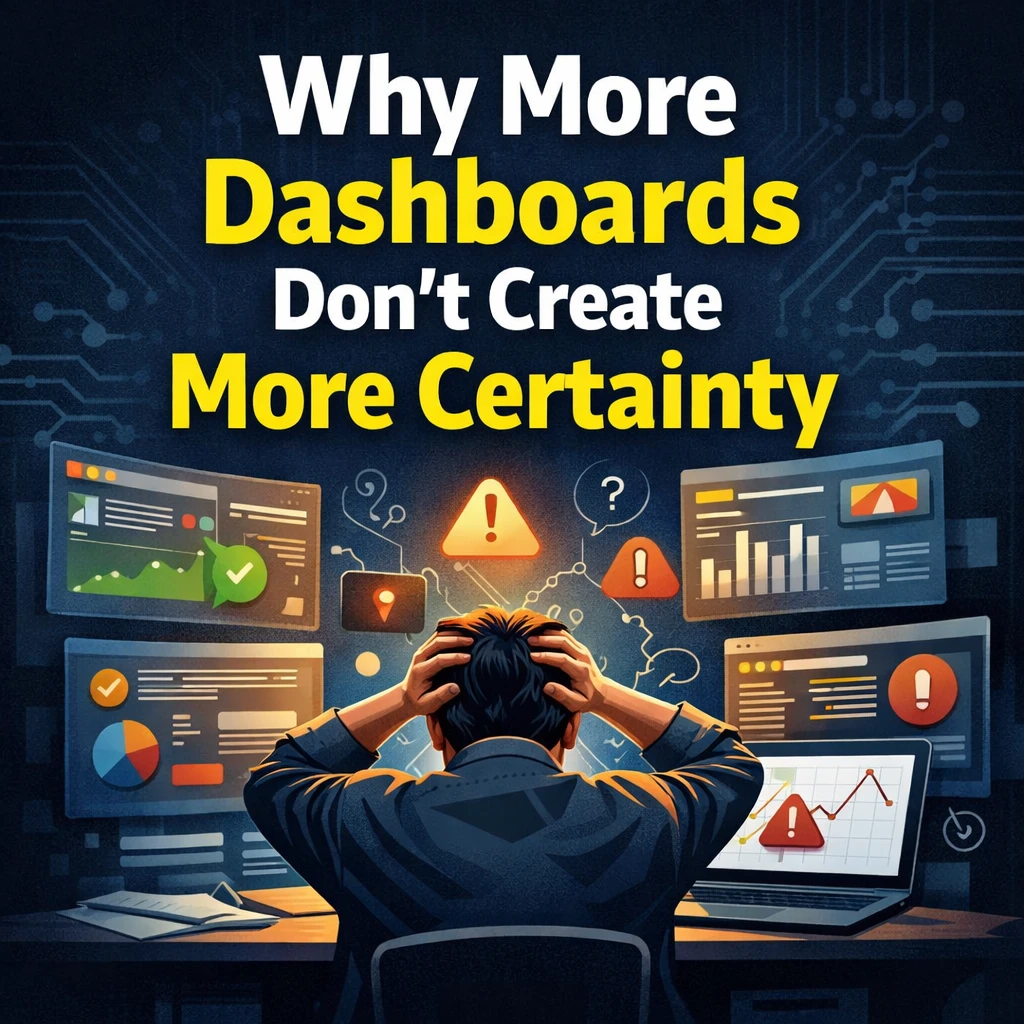
There is a common instinct when uncertainty appears in technical systems:
Add another dashboard.
If something feels unclear, the assumption is that we are missing data.
If decisions feel risky, we believe more visibility will help.
If confidence drops, we respond with more metrics, more charts, more tools.
And yet, for many teams, the opposite happens.
The more dashboards they add, the less certain they feel.
The Intuition Behind Dashboards (And Why It Makes Sense)
Dashboards exist for a good reason.
They promise:
- Visibility
- Control
- Transparency
- Reassurance
At their best, dashboards help answer questions like:
- Is the system up?
- Are we within normal ranges?
- Did something break?
In simple systems, this works remarkably well.
But modern websites are no longer simple systems.
When Visibility Turns Into Noise
As systems grow, dashboards multiply:
- Infrastructure dashboards
- Performance dashboards
- Analytics dashboards
- Error dashboards
- Security dashboards
Each dashboard is individually “correct”.
Together, they become overwhelming.
Instead of clarity, teams experience:
- Conflicting signals
- Competing priorities
- Constant low-level anxiety
- Fear of missing something important
Visibility increases.
Certainty decreases.
Dashboards Show State — Not Meaning
A core limitation of dashboards is this:
They show what is happening, not what it means.
A dashboard can tell you:
- CPU is at 72%
- Response time increased by 180ms
- Error rate rose slightly
- Traffic dipped by 5%
What it cannot tell you is:
- Is this normal?
- Is this connected to something else?
- Should I act — or wait?
- Does this matter for users?
Meaning is left to humans.
Humans Are Not Designed for Manual Correlation
Dashboards quietly assume that people will:
- Remember baselines
- Track changes across time
- Correlate unrelated metrics
- Infer causality under pressure
This expectation is unrealistic.
Humans are good at:
- Stories
- Sequences
- Cause and effect
Humans are bad at:
- Parallel timelines
- Abstract deltas
- Long-term drift
- Constant vigilance
The more dashboards you add, the more cognitive load you place on people.
Why “One More Dashboard” Feels Necessary
Adding dashboards is often a response to anxiety, not ignorance.
Common triggers:
- A past incident that felt surprising
- A stakeholder asking uncomfortable questions
- A sense that something subtle might be wrong
- Fear of being blamed later
Dashboards become a form of defensive infrastructure:
“If it’s on a dashboard, we’re covered.”
But coverage is not understanding.
Fragmentation Is the Hidden Cost
Each dashboard answers a narrow question.
None answers the whole one.
As a result:
- Context fragments
- Ownership blurs
- Responsibility diffuses
- Confidence erodes
When something feels wrong, teams bounce between dashboards:
- “Infra looks fine.”
- “Performance looks okay.”
- “Analytics dipped, but maybe seasonal?”
- “Security shows nothing unusual.”
Everything is visible.
Nothing is conclusive.
More Metrics ≠ More Trust
Ironically, excessive dashboards often reduce trust.
People begin to think:
- “If everything is measured, why don’t we understand this?”
- “Which dashboard should I believe?”
- “What am I not seeing?”
The system appears transparent —
but feels opaque.
This is a classic symptom of information without explanation.
Certainty Comes From Context, Not Coverage
Certainty doesn’t mean knowing everything.
It means knowing:
- What changed
- When it changed
- What it affected
- Whether it matters
Dashboards are excellent at coverage.
They are poor at context.
Context requires:
- Timelines
- Correlation
- Prioritization
- Narrative
Without these, data remains inert.
Why Dashboards Don’t Age Well
Dashboards tend to accumulate:
- New widgets
- Additional metrics
- Legacy charts no one questions
Over time:
- No one remembers why a metric exists
- Thresholds become arbitrary
- Alerts lose meaning
- Dashboards become ceremonial
They remain “important” — but not useful.
The False Choice: Visibility vs Simplicity
Teams often believe they must choose between:
- Rich visibility
- Simple mental models
This is a false choice.
The problem isn’t having data.
The problem is who has to interpret it.
Dashboards push interpretation onto humans.
Observability systems take responsibility for interpretation.
What Actually Creates Certainty
Certainty emerges when systems answer questions humans actually ask:
- What changed recently?
- Is this expected or unusual?
- Is this connected to something else?
- Should I care right now?
This requires:
- Fewer surfaces, not more
- Summaries, not raw feeds
- Explanations, not charts
- Memory, not snapshots
From Dashboards to Understanding
This doesn’t mean dashboards should disappear.
They still matter for:
- Deep investigation
- Specialized analysis
- Expert workflows
But dashboards should be supporting tools, not the primary interface for confidence.
Understanding should come first.
Details should come second.
The Shift in Mental Model
Instead of asking:
“Do we have enough dashboards?”
The better question is:
“Do we understand what’s happening?”
If the answer is no, adding another dashboard won’t help.
It will only add noise.
Conclusion: Certainty Is a Human Outcome
Dashboards are technical artifacts.
Certainty is a human experience.
It arises when:
- Information is contextualized
- Change is explained
- Risk is visible
- Silence is meaningful
More dashboards don’t create more certainty.
Understanding does.
Certainty doesn’t come from volume — it comes from knowing when nothing requires attention, which is why reassurance is a feature, not a luxury.
Key Takeaways
Understanding is a human outcome. It emerges from explanation, correlation, and narrative — not from more charts.
More dashboards don’t equal more understanding. They increase visibility, but often reduce certainty by adding noise and cognitive load.
Dashboards show state, not meaning. They report metrics, but leave humans to interpret whether something matters.
Humans aren’t built for manual correlation. Asking people to connect dozens of metrics across time leads to anxiety, not clarity.
Uncertainty often drives dashboard sprawl. Teams add dashboards to feel safer, not because they lack data.
Certainty comes from context, not coverage. Knowing what changed, when, and why matters more than seeing everything.
Dashboards should support understanding, not replace it. They work best as secondary tools, not the primary interface.
Know What’s Happening — Without Guessing.
WPMissionControl watches over your WordPress site day and night, tracking uptime, security, performance, and visual integrity.
AI detects and explains changes, warns about risks, and helps you stay one step ahead.
Your site stays safe, transparent, and under your control — 24/7.