


3/5/2026, 09:41:19
Why AI Only Becomes Useful After Data Discipline
Artificial intelligence is often presented as a shortcut to clarity.
Add an AI layer, connect it to your data, and suddenly your system becomes intelligent. Problems are explained, patterns are revealed, and decisions become easier.
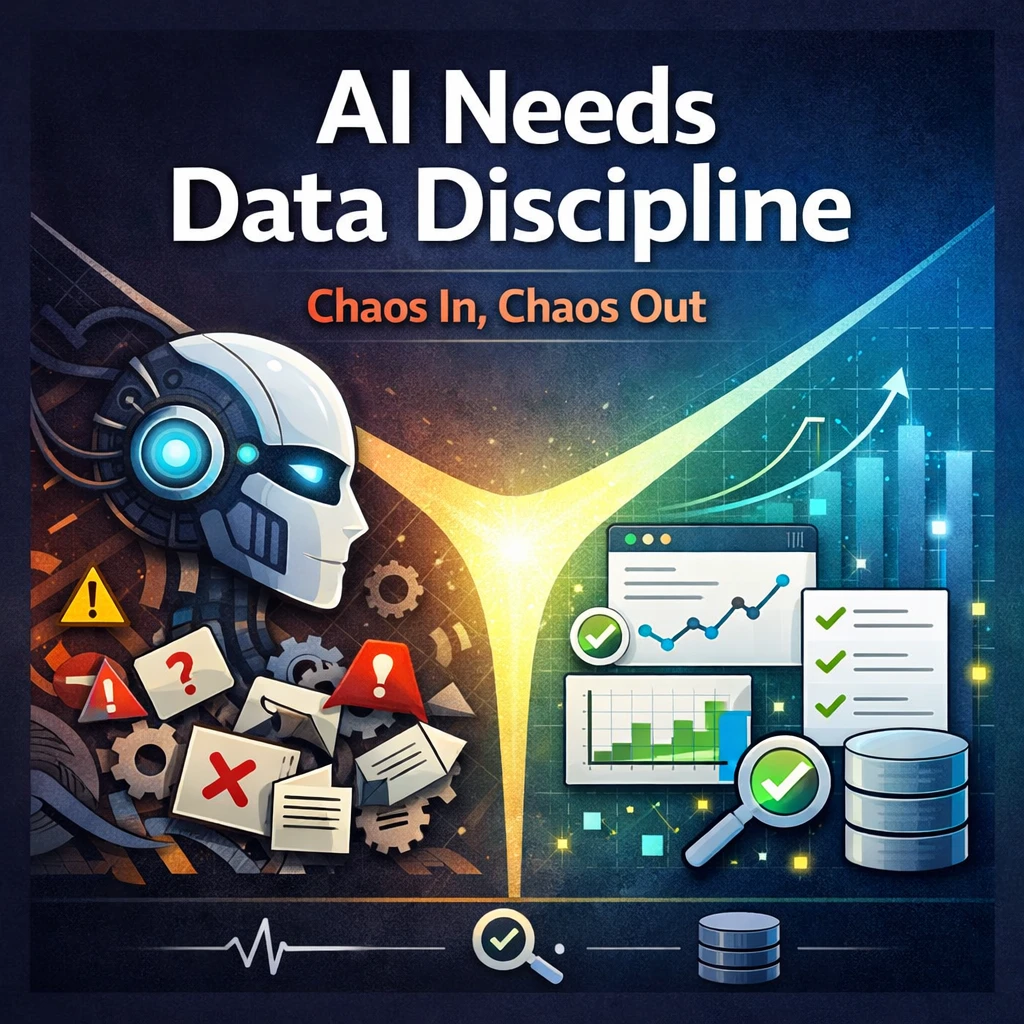
In reality, AI rarely solves chaos.
More often, it amplifies it.
If the underlying signals are inconsistent, incomplete, or noisy, AI simply turns that confusion into more convincing-looking confusion.
Before AI becomes useful, something more fundamental has to exist first: data discipline.
AI Can Only Interpret What Exists
AI systems don’t create knowledge from nothing. They work by interpreting patterns in existing data.
That means the quality of any AI output is constrained by three simple questions:
- What signals are collected?
- How consistently are they recorded?
- How clearly are they structured?
If those answers are weak, the AI layer cannot fix the problem.
Instead, it produces explanations that sound intelligent but are built on incomplete context.
For example, an AI system analyzing website health might see:
- an uptime alert
- a spike in response time
- a plugin update
- a sudden drop in conversions
Without disciplined signals connecting those events, AI cannot reliably determine whether these are related. It can only speculate.
The Real Work Happens Before AI
Many teams try to introduce AI before establishing reliable monitoring practices.
They ask questions like:
- Can AI tell us why the site slowed down?
- Can AI detect anomalies automatically?
- Can AI summarize our operational data?
But those questions assume something important already exists: structured operational data.
In practice, most websites operate with fragmented information:
- uptime monitors in one tool
- security logs in another
- server metrics elsewhere
- plugin updates recorded nowhere
AI cannot meaningfully interpret fragmented data sources.
It first needs consistent signals collected over time.
That process is what we call data discipline.
What Data Discipline Actually Means
Data discipline does not require massive infrastructure.
It simply means treating operational signals as structured information rather than occasional events.
For websites, this usually involves three practices:
Consistent signal collection
Key signals must be measured continuously rather than sporadically.
Examples include:
- uptime checks
- response times
- SSL certificate status
- file integrity changes
- plugin and theme updates
Consistency matters more than complexity.
Standardized data structure
Signals should follow predictable formats so they can be compared across time.
For example:
- health scores that follow a defined scale
- structured event logs
- timestamped metrics
Without structure, AI cannot reliably detect patterns.
Historical continuity
AI becomes powerful when it can analyze change over time.
This requires historical data.
A single snapshot of system state rarely explains anything.
But a sequence of snapshots reveals trends:
- performance degradation
- recurring downtime patterns
- security anomalies
- gradual configuration drift
These patterns are where AI begins to add real value.
Why Many “AI Tools” Feel Disappointing
When AI is layered on top of poorly structured data, it often produces results that feel superficial.
You might see features like:
- automated summaries
- anomaly alerts
- predictive insights
But if the underlying signals are incomplete, those outputs remain shallow.
The system might say:
“Response time increased significantly.”
But without contextual signals, it cannot answer the question that actually matters:
Why?
This is why many AI tools feel impressive during demos but less helpful in daily operations.
They are trying to interpret signals that were never organized for interpretation.
Where AI Actually Starts Becoming Powerful
Once disciplined signals exist, AI can begin to perform meaningful work.
At that point, it can help with tasks such as:
Pattern recognition
AI can detect relationships between events that humans might overlook.
For example:
- performance changes after plugin updates
- recurring downtime during specific time windows
- correlations between traffic spikes and server behavior
Contextual summaries
AI can compress large volumes of operational data into clear explanations.
Instead of reviewing dozens of metrics manually, teams can receive summaries like:
- what changed
- what might have caused it
- whether action is needed
Decision support
With sufficient historical context, AI can assist with operational decisions:
- prioritizing incidents
- distinguishing noise from real problems
- suggesting likely causes
At this stage, AI becomes less of a novelty and more of a practical assistant.
Observability Comes Before AI
This is why observability matters.
Observability creates the structured foundation that AI can actually work with.
It ensures that:
- signals are collected consistently
- events are recorded with context
- system state can be understood over time
Only after that foundation exists can AI meaningfully interpret the system.
Without it, AI becomes little more than a layer of guesswork.
The Real Role of AI in Website Operations
AI is not a replacement for monitoring discipline.
It is a multiplier for it.
When signals are reliable, structured, and historical, AI can help turn raw data into understanding.
But the order matters:
- Monitoring creates signals
- Observability organizes them
- AI interprets them
Reversing that order rarely works.
Key Takeaways
- AI cannot create clarity from chaotic data.
- Useful AI requires consistent, structured signals collected over time.
- Data discipline is the foundation that allows AI to interpret systems meaningfully.
- Observability organizes signals so AI can detect patterns and relationships.
- AI works best as a layer of interpretation — not as a replacement for monitoring.
Know What’s Happening — Without Guessing.
WPMissionControl watches over your WordPress site day and night, tracking uptime, security, performance, and visual integrity.
AI detects and explains changes, warns about risks, and helps you stay one step ahead.
Your site stays safe, transparent, and under your control — 24/7.