


3/14/2026, 09:49:39
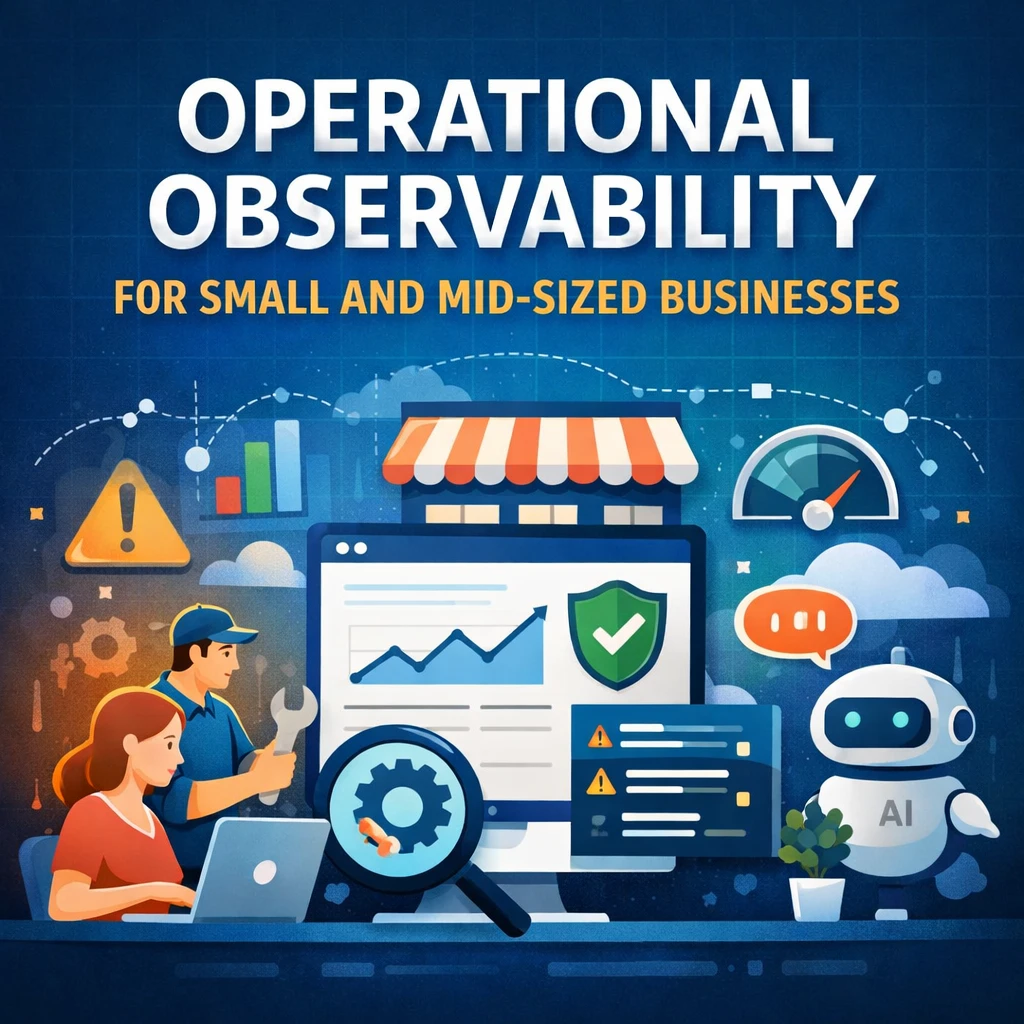
Operational Observability for Small and Mid-Sized Businesses
Introduction: The Visibility Gap in Small Organizations
In large technology companies, observability has become a standard discipline. Teams invest heavily in monitoring infrastructure, metrics pipelines, dashboards, logging systems, and incident management processes.
But most websites in the world are not run by large engineering organizations.
They are run by:
- small businesses
- marketing teams
- freelancers
- digital agencies
- e-commerce operators
- consultants
- founders wearing multiple hats
These organizations depend heavily on their websites — often as their primary revenue channel — yet they rarely have the operational visibility that larger companies take for granted.
The result is a familiar pattern.
Problems are discovered only after damage has already occurred:
- a website slows down for weeks before someone notices
- a plugin vulnerability remains unpatched until the site is hacked
- an SSL certificate expires unexpectedly
- a checkout process breaks silently
- a domain renewal fails
- a site is partially broken after an update
None of these problems are particularly rare.
What is rare is having a structured way to detect, interpret, and respond to them early.
This is where operational observability becomes essential — not just for large engineering teams, but especially for small and mid-sized organizations that cannot afford surprises.
Operational observability is not about adding more dashboards or alerts.
It is about making a website understandable as a system.
1. Why Traditional Monitoring Falls Short for SMBs
Many small businesses already use some form of monitoring.
The most common example is uptime monitoring.
A typical setup might include:
- a basic uptime checker
- an occasional performance scan
- manual plugin updates
- backups running in the background
These tools are useful, but they address only a small part of the operational picture.
Uptime monitoring answers a single question:
Is the website responding?
But operational reliability involves many other dimensions.
A site can be “online” while still having serious problems:
- performance degradation
- broken layouts
- plugin conflicts
- expired security certificates
- malware injections
- domain expiration risks
- slow database queries
- failed background jobs
In practice, many small organizations operate with partial visibility.
They have fragments of information scattered across tools, but no clear way to combine them into a coherent understanding of what is actually happening.
This is the difference between monitoring and observability.
Monitoring detects specific predefined events.
Observability helps you understand the behavior of the system as a whole.
2. The Operational Reality of Small Teams
To understand why observability matters for SMBs, it is important to look at how small teams actually work.
Unlike large engineering organizations, small businesses typically operate under several constraints.
Limited Time
The same person may be responsible for:
- marketing
- customer support
- content updates
- plugin maintenance
- hosting issues
Website maintenance is often done in between other tasks, not as a dedicated role.
Limited Technical Depth
Many site owners are not engineers.
They may rely on:
- freelancers
- agencies
- hosting support
- plugin vendors
When something breaks, diagnosing the cause can be difficult.
Limited Tooling
Enterprise observability platforms are usually designed for:
- microservices architectures
- Kubernetes clusters
- large DevOps teams
They are rarely practical for a small WordPress site or a marketing team.
Limited Tolerance for Failure
For many small businesses, a website is not just a digital presence.
It is:
- the main sales channel
- the lead generation engine
- the booking system
- the customer portal
Even a small disruption can directly impact revenue.
This combination of constraints creates a paradox.
Small organizations often depend on their websites more than large companies, yet they have far less operational visibility.
3. What Operational Observability Actually Means
Operational observability for SMBs is not about replicating enterprise DevOps practices.
It is about creating a clear operational picture of a website in a way that is:
- simple
- understandable
- actionable
At its core, operational observability answers four practical questions.
1. Is the system functioning normally?
Basic health signals include:
- uptime
- response time
- SSL validity
- domain expiration
These signals confirm that the infrastructure is working.
2. Is the system behaving as expected?
This includes changes such as:
- plugin updates
- file modifications
- performance regressions
- layout changes
These signals indicate whether the system is evolving in safe and predictable ways.
3. Are there emerging risks?
Examples include:
- outdated plugins
- security warnings
- performance trends
- failed login attempts
These signals help identify problems before they escalate into incidents.
4. What changed recently?
Many operational problems come down to one question:
What changed?
Understanding recent changes helps teams correlate issues with events such as:
- deployments
- plugin updates
- configuration changes
- traffic spikes
Together, these signals transform a website from a black box into a visible system.
4. Why Observability Is Especially Important for WordPress
WordPress powers a large portion of the internet, but its operational structure introduces unique challenges.
A typical WordPress site includes:
- the WordPress core
- multiple plugins
- themes
- external integrations
- hosting infrastructure
Each of these components evolves independently.
Plugins update.
Themes change.
Hosting environments shift.
Security vulnerabilities appear.
This creates a constantly changing operational landscape.
Many site issues are not caused by catastrophic failures, but by subtle interactions between components.
For example:
- a plugin update increases database load
- a theme modification breaks mobile layouts
- a security plugin blocks legitimate requests
- a caching misconfiguration slows down checkout
These issues may not immediately trigger alarms.
But they gradually degrade the reliability and performance of the site.
Operational observability helps detect these patterns before they become visible to customers.
5. The Difference Between Alerts and Understanding
Many monitoring systems are built around alerts.
When something crosses a threshold, a notification is sent.
Alerts are useful, but they have limitations.
Too few alerts mean problems go unnoticed.
Too many alerts create alert fatigue, where warnings are ignored.
Small teams often struggle with this balance.
Operational observability shifts the focus from alerts to understanding.
Instead of reacting only when something breaks, teams can observe:
- trends
- anomalies
- gradual changes
This approach allows problems to be addressed proactively rather than reactively.
For example:
Instead of receiving a sudden alert about a severe slowdown, a team might notice:
- response times gradually increasing over several days
- plugin updates that correlate with performance changes
- growing error rates
These signals provide context, making the issue easier to diagnose.
Observability turns isolated alerts into narratives about system behavior.
6. Operational Observability as a Routine
For small organizations, observability does not require constant monitoring.
Instead, it becomes part of a simple operational routine.
A typical cadence might include:
Daily
Quick health checks:
- uptime status
- security warnings
- unusual events
Weekly
Operational review:
- performance trends
- plugin updates
- recent system changes
Monthly
Strategic maintenance:
- dependency updates
- backup verification
- security review
This routine turns observability into a lightweight operational habit rather than a heavy technical process.
Even a few minutes of review can prevent many operational surprises.
7. The Role of Interpretation
One of the biggest challenges for small teams is not collecting data.
It is interpreting what the data means.
Raw metrics can be confusing.
For example:
- is a 200ms increase in response time significant?
- does a plugin update introduce a risk?
- is a spike in traffic normal or suspicious?
Without interpretation, metrics remain abstract numbers.
Operational observability helps translate signals into meaningful insights.
Instead of simply presenting data, systems can highlight:
- unusual patterns
- potential risks
- correlations between events
This reduces the cognitive load on teams that do not have dedicated operations specialists.
Interpretation turns data into operational guidance.
8. The Role of AI in Operational Observability
Artificial intelligence can play a role in operational observability — but only when a solid data foundation exists.
AI systems are good at identifying patterns, summarizing activity, and highlighting anomalies.
But they require structured signals to work with.
Without consistent monitoring data, AI has nothing meaningful to analyze.
This is why data discipline comes first.
Once reliable signals are collected, AI can help:
- summarize weekly activity
- identify recurring issues
- highlight potential risks
- explain operational trends
For small organizations, this can make observability far more accessible.
Instead of reading through multiple dashboards, teams can receive interpreted summaries of system behavior.
AI becomes useful not because it replaces monitoring, but because it helps interpret the signals that monitoring produces.
9. Observability as Operational Confidence
Ultimately, operational observability is about confidence.
Website operators want to know:
- the system is working
- risks are visible
- problems will not appear unexpectedly
This confidence has real value.
It reduces stress.
It improves decision-making.
It makes maintenance more predictable.
For agencies, observability also provides a way to demonstrate the value of their work.
Invisible operational care becomes visible through:
- reports
- status pages
- documented system health
Observability transforms website maintenance from a hidden activity into a transparent operational process.
10. Observability as a Competitive Advantage
As websites become more complex and more critical to business operations, operational reliability becomes a differentiator.
Organizations that understand their systems can:
- detect issues faster
- respond to incidents more effectively
- maintain higher uptime and performance
For agencies and service providers, this creates an opportunity.
Offering operational observability alongside development and maintenance services allows teams to deliver measurable reliability improvements.
Instead of simply building websites, they can ensure those websites remain stable, secure, and understandable over time.
Conclusion
Operational observability is often associated with large engineering organizations, but its principles are equally valuable for small and mid-sized businesses.
In many cases, these organizations depend even more heavily on their websites, while having fewer resources to diagnose problems when they arise.
By combining monitoring signals, interpretation, and structured operational routines, observability makes websites visible as systems rather than black boxes.
For small teams, this visibility provides something extremely valuable:
confidence that their digital infrastructure is working as expected.
And in a world where websites are often the foundation of business operations, that confidence is not just a technical improvement.
It is an operational necessity.
Know What’s Happening — Without Guessing.
WPMissionControl watches over your WordPress site day and night, tracking uptime, security, performance, and visual integrity.
AI detects and explains changes, warns about risks, and helps you stay one step ahead.
Your site stays safe, transparent, and under your control — 24/7.