


2/4/2026, 08:50:26
How Observability Works in Practice: From Signals to Decisions
Introduction: Why Observability Is About Decisions, Not Data
Most systems today are not short on information.
They are drowning in it.
Logs, metrics, alerts, dashboards, reports — modern software emits more signals than any human can reasonably process. And yet, when something breaks, the most common reaction is still confusion:
- What actually happened?
- Is this new or has it been going on for a while?
- Did something change — or is this just noise?
- Do I need to act right now?
This is the paradox at the heart of observability.
Despite all the tools, many people feel less certain, not more.
More visibility has not translated into better decisions.
That’s because observability, in practice, is not a data problem.
It’s a decision problem.
The Gap Between Signals and Confidence
Most monitoring systems are very good at answering one question:
“Did something happen?”
They are far less good at answering the questions people actually care about:
- Does this matter?
- Is this dangerous or expected?
- Is this related to something else?
- Can I safely ignore this?
As a result, users are forced into one of two unhealthy modes:
- Overreaction — treating every alert as an emergency
- Desensitization — ignoring alerts until something truly breaks
Neither leads to confidence. Both increase stress.
True observability exists in the space between raw signals and human judgment.
Observability Is Not the Same as Monitoring
Monitoring is about detection.
Observability is about understanding.
You can monitor a system without understanding it:
- Green lights
- Red alerts
- Thresholds crossed
But observability asks a different question altogether:
“Given everything I know, what should I do next?”
That “next” might be:
- Fix something immediately
- Schedule work for later
- Or deliberately do nothing
And doing nothing — consciously, confidently — is often the hardest outcome to reach.
Why This Matters Outside of Engineering Teams
Observability is often discussed in the context of large engineering organizations:
microservices, distributed tracing, SRE practices, and complex infrastructure.
But the same decision problem exists in much smaller systems:
- A WordPress website handling payments
- An agency managing dozens of client sites
- A small business relying on a single online checkout
- A founder who is the “on-call engineer” by default
In these environments, there is no dedicated incident response team.
There is just a person — often busy, often context-switching — who needs clarity, not complexity.
When observability fails here, the cost is not just downtime.
It’s mental overhead, constant uncertainty, and delayed action.
More Data Does Not Mean More Certainty
A common instinct when something feels unclear is to add more tools.
Another dashboard.
Another alert.
Another integration.
But without structure, more data often makes things worse.
Instead of:
- One unclear signal
You now have:
- Ten partially correlated ones
The human brain is excellent at recognizing patterns —
but only when the noise is controlled.
Observability is not about collecting everything.
It’s about collecting enough, and connecting it in a way that reduces ambiguity.
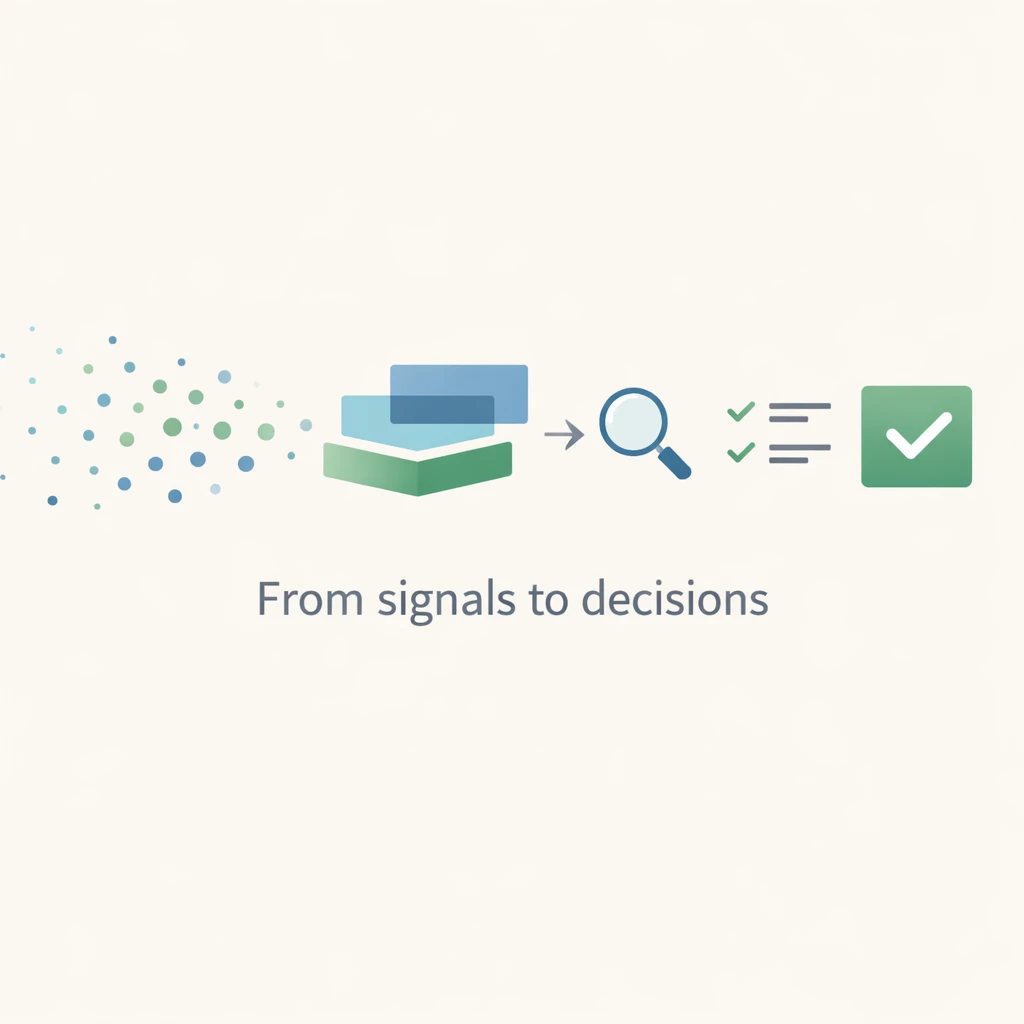
From Signals to Decisions
In practice, observability follows a simple but fragile path:
- Signals – things that happen
- Context – how those things relate
- Interpretation – what they mean
- Decision – what to do (or not do)
Most systems break this chain somewhere in the middle.
They generate signals, but leave interpretation to the user.
They provide context, but not conclusions.
They surface problems, but not priorities.
This article is about rebuilding that chain — deliberately and realistically.
What This Article Will (And Won’t) Do
This is not a vendor comparison.
It’s not a tooling guide.
It’s not a sales pitch.
Instead, we’ll look at observability as a practical workflow:
- How signals are generated in real systems
- Why context matters more than volume
- How interpretation reduces cognitive load
- How good observability leads to calmer, faster decisions
Whether you’re an engineer, a site owner, or someone responsible for “making sure things don’t break”, the goal is the same:
To replace uncertainty with informed choice.
1. Signals: The Raw Facts Your System Emits
Every system speaks.
It just doesn’t speak in sentences.
It speaks in signals — small, factual events that describe what is happening right now, or what has just changed. Signals are the most basic building blocks of observability. Without them, there is nothing to reason about.
But signals are also where most confusion begins.
What Exactly Is a Signal?
A signal is a single, observable fact about a system.
Examples:
- An HTTP request returned
500 - Response time increased by 40%
- A file checksum no longer matches
- A plugin was updated
- A payment attempt failed
- A screenshot changed compared to yesterday
- An SSL certificate now expires in 14 days
Signals are:
- Objective
- Timestamped
- Context-free by default
They answer only one question:
“Did something happen?”
They do not answer:
- Why it happened
- Whether it’s important
- Whether it’s related to anything else
That limitation is fundamental — and unavoidable.
The Signal Explosion Problem
Modern systems emit far more signals than humans can track.
Even a “simple” website can generate:
- Thousands of HTTP requests per hour
- Continuous performance metrics
- Background cron jobs
- Plugin and theme activity
- Security-related probes and scans
- User behavior events
- Scheduled maintenance actions
Individually, these signals are harmless.
Collectively, they create a problem:
Signal abundance without structure leads to cognitive overload.
When everything is visible, nothing stands out.
Why More Signals Rarely Help
A common response to uncertainty is to add more instrumentation.
If you don’t understand what’s happening:
- Add logs
- Add alerts
- Add checks
- Add dashboards
This works temporarily — until the volume increases again.
The uncomfortable truth is:
Most systems already emit enough signals.
The issue is not lack of data, but lack of framing.
Without framing:
- Important signals drown in background noise
- Minor anomalies feel critical
- Critical issues arrive disguised as “just another alert”
Signals Are Not Problems
One of the most damaging misconceptions is treating signals as problems.
A signal is not a verdict.
It’s a clue.
Examples:
- A 404 error is not a problem — it’s a symptom
- A changed file is not an attack — it’s a fact
- A slower response time is not a failure — it’s an observation
Problems emerge only after interpretation.
When systems skip this distinction, users are trained to:
- React emotionally
- Overestimate risk
- Distrust alerts altogether
Good observability protects the user from this reflex.
Types of Signals You Encounter in Practice
Not all signals are equal. They usually fall into a few broad categories:
Availability Signals
- Uptime checks
- Connection failures
- Timeouts
These answer:
“Is it reachable?”
Performance Signals
- Response times
- Resource usage
- Trend deviations
These answer:
“Is it getting worse?”
Integrity Signals
- File changes
- Unauthorized modifications
- Missing or altered assets
These answer:
“Did something change that shouldn’t have?”
Behavior Signals
- Payment failures
- Form submission errors
- Checkout interruptions
These answer:
“Did a real user experience break?”
Visual Signals
- Layout changes
- Broken rendering
- Missing elements
These answer:
“Does it still look the way it should?”
Each category is useful — but none is sufficient on its own.
Why Raw Signals Create Anxiety
When systems surface signals without interpretation, they place the burden on the human.
The user is forced to ask:
- Is this normal?
- Is this urgent?
- Is this connected to something else?
- Have I seen this before?
Over time, this leads to alert fatigue, even in small systems.
The issue is not that signals exist —
it’s that they arrive without guidance.
The Role Signals Should Play
Signals are not meant to be consumed directly.
Their real purpose is to serve as input material for higher-level reasoning.
In healthy observability systems:
- Signals are collected quietly
- Stored consistently
- Compared historically
- Correlated across dimensions
Only then do they graduate into something meaningful.
Which brings us to the missing layer in most setups:
Context.
In the next section, we’ll explore how context transforms isolated events into a coherent narrative — and why this step is where observability either succeeds or collapses.
2. Context: Turning Isolated Events Into a Coherent Story
A signal tells you that something happened.
Context tells you what that something means in relation to everything else.
Without context, every signal is an island.
With context, signals become a story.
This is the layer where observability stops being mechanical and starts being human.
What Context Actually Is
Context is any information that helps answer:
“Compared to what?”
It can include:
- Time (before vs after)
- History (first occurrence vs recurring)
- Relationships (this changed after that)
- Scope (one page vs the entire site)
- Intent (expected action vs unexpected change)
Context does not add new facts.
It reframes existing ones.
The same signal, seen through different context, can flip from harmless to critical — or the other way around.
Why Raw Signals Fail Without Context
Consider this signal:
Response time increased by 300ms.
On its own, this is meaningless.
With context:
- Gradual increase over 7 days → capacity issue brewing
- Sudden spike after deployment → regression
- Happens only during backups → expected
- Happens only for logged-in users → scoped issue
The signal didn’t change.
Your confidence did.
That confidence comes from context.
Time Is the First and Most Important Context
Almost every meaningful question in observability is temporal.
- Is this new?
- Has this happened before?
- Is it getting worse?
- Did this start after something else changed?
Time turns events into trends.
A single error is noise.
The same error repeating daily is a pattern.
Observability systems that lack historical comparison force users to guess — or remember manually, which is unreliable and exhausting.
Change-Based Context: “What Just Happened?”
Humans are exceptionally good at reasoning about change.
We instinctively ask:
- What was different yesterday?
- What did I touch last?
- What changed right before this broke?
Good context layers align with this instinct.
Examples:
- Error appeared right after plugin update
- Layout changed after content edit
- Integrity warning during scheduled deployment
- Performance degradation after traffic increase
Change-based context collapses search space.
Instead of “everything could be wrong”, it becomes:
“It’s probably related to this.”
That alone reduces stress dramatically.
Correlation: When Signals Stop Being Lonely
Context also comes from relationships between signals.
One alert is ambiguous.
Multiple aligned signals tell a story.
Examples:
- Uptime drop + payment failures → business impact
- File change + unknown IP + no deployment → security concern
- Slow response + CPU spike + cron job → resource contention
- Visual diff + CSS file change → expected side effect
Correlation does not require perfect causality.
It only needs plausible alignment.
Most observability failures happen because signals are presented in isolation.
Scope and Blast Radius
Context also answers:
“How big is this problem?”
A broken page is not the same as a broken site.
A single failed payment is not the same as a checkout outage.
Scope helps prioritize.
Examples:
- One URL vs all URLs
- One user vs many users
- One region vs global
- One site vs entire portfolio
Without scope:
- Small issues feel catastrophic
- Big issues arrive quietly
Good observability systems surface blast radius early.
Expected vs Unexpected: The Forgotten Dimension
One of the most powerful contextual signals is intent.
Did this happen because:
- Someone did something on purpose?
- Or because something went wrong?
Examples:
- File changed during update window → expected
- File changed at night with no activity → suspicious
- Layout change after content edit → expected
- Layout change with no edits → concerning
Most systems know what changed.
Very few know whether it was supposed to.
That gap is where anxiety lives.
Context Reduces False Positives — And Panic
When systems lack context, they rely on thresholds.
Thresholds are blunt instruments:
- Too sensitive → noise
- Too loose → blind spots
Context softens thresholds into judgments.
Instead of:
“Alert fired.”
You get:
“This changed, but under expected conditions.”
That subtle shift turns alerts into information — not interruptions.
Context Is a Compression Layer
Context is not about adding more data.
It’s about compressing meaning.
It reduces:
- 50 events → one explanation
- 20 metrics → one trend
- 10 alerts → one decision point
This compression is what makes observability usable outside of engineering teams.
Why Context Is Where Most Tools Stop
Context is hard.
It requires:
- Remembering history
- Understanding relationships
- Tracking intent
- Comparing across dimensions
It’s much easier to ship dashboards than narratives.
But without context, observability tools become:
- Reactive
- Stress-inducing
- Distrusted over time
Context is the difference between:
“Something happened”
and
“Here’s what changed, and why it likely matters.”
Context Sets the Stage for Interpretation
Signals tell you what happened.
Context tells you how to think about it.
But one step is still missing.
Even with perfect context, the user still has to decide:
- Is this bad?
- Is this urgent?
- Is this worth action?
That final step is interpretation — the layer where systems either empower decisions or abandon the user.
That’s where we go next.
3. Interpretation: Deciding What a Signal Actually Means
Signals tell you what happened.
Context tells you how it relates to everything else.
Interpretation answers the hardest question:
“So… should I care?”
This is the layer most observability systems quietly skip — not because it’s unimportant, but because it’s difficult, subjective, and uncomfortable.
Yet without interpretation, observability stops just short of usefulness.
Why Interpretation Is the Missing Layer
Most tools assume the user will interpret signals themselves.
They present:
- Timelines
- Charts
- Correlations
- Logs
And then implicitly say:
“Here’s the data. You figure it out.”
That works for:
- Engineers with time
- Investigations after the fact
- People who live inside systems all day
It fails for everyone else.
Interpretation is where observability must absorb complexity on behalf of the user.
Interpretation Is Not Guessing
Interpretation is not intuition.
It’s not vibes.
It’s not “AI magic”.
Good interpretation is bounded reasoning:
- Based on known patterns
- Constrained by context
- Explicit about uncertainty
It does not claim certainty where none exists.
It narrows possibilities.
Instead of:
“Something is wrong.”
You get:
“This looks like X, likely caused by Y, with Z level of risk.”
That alone changes how people respond.
Severity Is Not Binary
One of the biggest interpretation failures is treating everything as either:
- Fine
- Broken
Reality has more nuance.
Interpretation introduces gradation:
- Informational
- Notice-worthy
- Risky
- Urgent
- Critical
Two identical events can land in different categories depending on context.
Example:
- A failed payment at 03:00 → informational
- A spike in failed payments during checkout → urgent
The signal didn’t change.
The meaning did.
Interpretation Filters False Urgency
Humans are biased toward urgency.
Alerts exploit this bias.
Interpretation acts as a buffer between the system and human stress.
Examples:
- A file changed — but checksum matches known version
- Response time increased — but still within historical variance
- Layout diff detected — but caused by content edit
Without interpretation, these trigger anxiety.
With interpretation, they become notes.
This is how observability prevents alert fatigue without hiding information.
“Expected” Is a Powerful Verdict
One of the most underrated interpretive outcomes is:
Expected behavior.
Labeling something as expected:
- Defuses panic
- Builds trust
- Teaches the system’s behavior over time
Ironically, many systems only flag anomalies, never confirming normalcy.
But reassurance is a feature.
Knowing that something changed and that it’s okay is often more valuable than detecting failures.
Interpretation Is Where Trust Is Built
Users don’t trust systems that cry wolf.
They don’t trust systems that stay silent either.
Trust emerges when interpretation is:
- Consistent
- Explainable
- Conservative in claims
- Transparent about uncertainty
If a system says:
“This might matter because…”
And it’s usually right — users listen.
If it says:
“Critical issue detected!”
And it’s usually noise — users stop caring.
Interpretation Is Not the Same as Automation
Interpretation does not mean auto-fixing.
It means:
- Framing
- Prioritization
- Guidance
Sometimes the best interpretation is:
“No action needed.”
Sometimes it’s:
“Schedule this.”
Sometimes it’s:
“Act now.”
The power lies in clarifying the choice, not forcing one.
Interpretation Reduces Cognitive Load
Cognitive load is the hidden cost of poor observability.
Every uninterpreted signal costs:
- Attention
- Time
- Emotional energy
Interpretation compresses mental effort.
Instead of asking users to:
- Compare
- Remember
- Correlate
- Decide
The system does most of that work upfront.
This is what makes observability sustainable over months and years — not just during incidents.
The Risk of Over-Interpretation
There is a danger on the other side.
Overconfident interpretation:
- Hides uncertainty
- Misses edge cases
- Creates false reassurance
Good systems leave room for doubt.
They say:
- “Likely”
- “Possibly”
- “Based on recent changes”
Interpretation should guide, not dictate.
Interpretation Prepares the Ground for Decisions
At this point, the system has done most of the heavy lifting.
The user now sees:
- What happened
- How it fits into context
- What it probably means
- How serious it might be
Only one step remains:
What should I do?
That final step — turning understanding into action (or inaction) — is where observability completes its purpose.
That’s where decisions live.
4. Decisions: Acting, Scheduling, or Choosing Not to Act
Observability does not exist to inform.
It exists to enable decisions.
Signals without decisions are just facts.
Context without decisions is just understanding.
Interpretation without decisions is just insight.
The moment observability becomes useful is when it helps someone decide what to do next — or to consciously do nothing.
The Three Outcomes Every Signal Should Lead To
In practice, every interpreted signal should resolve into one of three paths:
- Act now
- Schedule action
- Ignore with confidence
Most systems only support the first option.
Good observability supports all three.
1. Act Now: When Delay Is Risk
Some situations require immediate action.
Characteristics:
- Clear impact
- Escalating damage
- High confidence in interpretation
Examples:
- Website is down
- Payments are failing
- Malware detected
- Data integrity compromised
In these moments, observability should:
- Remove ambiguity
- Surface root context
- Minimize decision friction
The goal is not panic — it’s fast clarity.
The system should answer:
- What is broken?
- Since when?
- How widespread?
- What changed recently?
Good observability shortens the time between detection and first meaningful action.
2. Schedule Action: When Timing Matters More Than Speed
Not all issues are emergencies.
Many are:
- Predictable
- Gradual
- Manageable with planning
Examples:
- SSL certificate expiring in 10 days
- Plugin update required
- Performance degradation trend
- Storage slowly filling up
These are not “alerts”.
They are planning inputs.
Observability systems often mishandle these by:
- Alerting too early
- Alerting too loudly
- Alerting repeatedly
Better observability reframes them as:
“This will require attention — but not right now.”
This preserves urgency without creating stress.
3. Ignore With Confidence: The Most Valuable Outcome
This is the outcome almost no system optimizes for.
Yet it’s the one users crave most.
Choosing not to act — and knowing that it’s safe — is a form of relief.
Examples:
- Expected file change during update
- Known performance dip during backup
- Layout change after content edit
- One-off error with no recurrence
Ignoring something blindly is risky.
Ignoring something informed by observability is responsible.
This is where trust is built.
Why “Do Nothing” Is Not Failure
Many people equate observability with vigilance.
But constant vigilance is unsustainable.
Good observability:
- Filters out irrelevance
- Confirms normal behavior
- Reduces unnecessary action
Inaction, when justified, is efficiency.
A system that helps users not act unnecessarily is protecting their time and attention.
Decision Support Beats Decision Automation
There is a temptation to automate decisions:
- Auto-fix
- Auto-restart
- Auto-block
- Auto-update
Sometimes this is appropriate.
But in many real-world systems — especially those tied to business impact — automation without understanding is dangerous.
Decision support is safer:
- Clear recommendations
- Transparent reasoning
- Human approval when needed
Observability should empower, not override.
Decisions Are Emotional, Not Just Logical
This is rarely acknowledged.
When something breaks, people feel:
- Stress
- Fear
- Urgency
- Responsibility
Poor observability amplifies these emotions.
Good observability contains them.
By reducing ambiguity, observability:
- Lowers anxiety
- Improves confidence
- Prevents impulsive actions
This emotional regulation is an underrated feature — but a critical one.
Closing the Loop: From Events to Outcomes
At its best, observability creates a closed loop:
- Something happens
- The system notices
- It explains what likely happened
- It frames how serious it is
- It suggests what to do
- The user decides calmly
When this loop works, observability becomes invisible.
You don’t think about it — you trust it.
Decisions Are Where Value Is Realized
Everything before this point is potential.
Value is realized only when:
- Downtime is prevented
- Issues are caught early
- Panic is avoided
- Time is saved
- Confidence is maintained
This is why observability is not a technical luxury.
It’s an operational necessity.
From Decisions to Reassurance
When observability consistently leads to good decisions — including the decision to do nothing — something subtle happens:
People stop worrying.
They don’t check dashboards compulsively.
They don’t second-guess silence.
They don’t react to every anomaly.
They trust the system.
And that trust is the highest form of observability maturity.
Observability in Practice: A Real WordPress Case Study
Let’s move away from theory and look at how observability actually plays out in a common WordPress setup.
Not a large enterprise stack.
Not a hypothetical system.
Just a real-world website that:
- Runs WooCommerce
- Uses several plugins
- Handles payments
- Is business-critical
- Has no dedicated ops team
In other words: the reality for most WordPress site owners and agencies.
The Setup
Imagine a mid-sized WordPress site:
- WooCommerce store with subscriptions
- 20–30 active plugins
- Regular content edits
- Occasional plugin updates
- Nightly backups
- Real revenue impact if something breaks
There is no full-time engineer watching dashboards.
There is just a person who wants the site to keep working.
Day 1: Signals Appear
Over a 24-hour period, the system emits several signals:
- One short downtime event (2 minutes)
- A small increase in response time
- A plugin update was installed
- A file integrity change was detected
- One failed payment retry
- A visual difference on a product page
Individually, none of these are dramatic.
Together, they could mean anything — or nothing.
This is where traditional monitoring stops being helpful.
Without Observability: What Usually Happens
In a typical setup, these signals arrive as:
- Separate alerts
- Separate logs
- Separate dashboards
- Separate moments of anxiety
The site owner now has to:
- Remember what changed
- Guess what is related
- Decide whether to investigate
- Decide whether to ignore
Most people either:
- Overreact (“Something is wrong, I should check everything”), or
- Ignore it all until a customer complains
Neither is ideal.
With Observability: The Same Signals, Interpreted
Now let’s run the same signals through an observability lens.
Step 1: Context Is Applied
The system notices:
- Downtime happened during a scheduled plugin update
- Response time increase started after that update
- File change matches the updated plugin’s checksum
- Visual change occurred on the same page affected by the plugin
- Payment retry failure is isolated and recovered automatically
Nothing here is treated in isolation.
The signals are connected into a single narrative.
Step 2: Interpretation Reduces Uncertainty
Instead of six “things”, the system arrives at one interpretation:
A plugin update caused a short service interruption and a minor layout change.
The issue resolved itself. No ongoing failures detected.
Severity is assessed as:
- Low
- Non-recurring
- Expected side effects
No panic language.
No red flashing alerts.
Just clarity.
Step 3: Decision Support Emerges
The system now guides the user toward three decisions:
- No immediate action required
- Review layout change later if needed
- Monitor performance trend over the next 48 hours
Crucially, it also confirms:
Payments are functioning normally.
That single sentence often matters more than all metrics combined.
What Did Not Happen — And Why That Matters
Because observability worked:
- No unnecessary rollback
- No late-night debugging
- No disabling plugins blindly
- No stress-driven decisions
- No checking dashboards every hour
The system absorbed complexity so the human didn’t have to.
Why This Is Different From “Just Monitoring”
Monitoring would have shown:
- Downtime
- Errors
- Changes
Observability answered:
- Is this related?
- Is this expected?
- Is this still happening?
- Do I need to act?
The difference is not volume of data.
It’s quality of conclusions.
The Real Business Impact
Nothing was “fixed” that day.
And that’s the point.
Observability prevented:
- Overreaction
- Distraction
- Risky changes
- Lost time
The site stayed stable.
The owner stayed calm.
The business stayed uninterrupted.
That outcome is invisible — but incredibly valuable.
Observability for WordPress Is About Reassurance
WordPress sites don’t usually fail catastrophically.
They fail subtly:
- Slowly
- Quietly
- In ways that create doubt
Good observability doesn’t just detect failure.
It provides reassurance when things are okay.
And reassurance is what allows people to focus on their actual work — instead of worrying whether their site is about to break.
Conclusion: Observability Is the Path From Uncertainty to Trust
Observability is often framed as a technical capability.
In practice, it is a human one.
It exists to help people make decisions under uncertainty — calmly, consistently, and with confidence.
From Seeing Everything to Understanding Enough
The journey we’ve walked through is deliberately simple:
- Signals show that something happened
- Context explains how it fits into the bigger picture
- Interpretation clarifies what it likely means
- Decisions determine what to do — or not do
Each step reduces ambiguity.
Each step removes unnecessary cognitive load.
The goal is not perfect knowledge.
It’s sufficient understanding.
Enough to act.
Enough to wait.
Enough to move on without doubt.
Why Observability Feels So Different When It Works
When observability works, something subtle happens:
- Alerts stop feeling alarming
- Silence stops feeling suspicious
- Change stops feeling dangerous
People stop checking dashboards compulsively.
They stop reacting emotionally to every anomaly.
They stop guessing.
Instead, they trust that:
If something truly matters, it will surface — with context.
That trust is not accidental.
It’s engineered.
Observability Is Not About Control
Many systems promise control:
- Full visibility
- Total awareness
- Immediate reaction
But control is an illusion.
What people actually need is confidence.
Confidence that:
- Important changes won’t go unnoticed
- Expected changes won’t cause panic
- Problems will be caught early, not late
- Inaction can be a valid choice
Observability provides that confidence — not by showing more, but by explaining better.
The Quiet Value of “Nothing Happened”
One of the highest forms of observability maturity is this outcome:
Nothing happened — and you know why.
No alerts.
No incidents.
No investigation.
Just a calm confirmation that systems behaved as expected.
That outcome doesn’t show up in reports.
It doesn’t create stories.
But it protects time, focus, and mental energy.
And over months and years, that protection compounds.
Why This Matters Especially for WordPress and Small Systems
In smaller systems, observability is not about scale.
It’s about responsibility density.
Often, the same person is:
- Owner
- Operator
- Support
- Incident responder
They don’t need more tools.
They need fewer questions.
Good observability answers questions before they are asked.
Observability Is a Practice, Not a Product
No tool alone creates observability.
Observability emerges from:
- Thoughtful signal collection
- Meaningful context
- Careful interpretation
- Respect for human attention
Tools can support this.
They can accelerate it.
But they cannot replace the mindset.
That mindset is what turns data into decisions — and decisions into trust.
The Real Outcome: Peace of Mind
At the end of the day, observability is not about uptime percentages or alert counts.
It’s about peace of mind.
Knowing that:
- You are not blind
- You are not overreacting
- You are not missing something critical
And that when action is required, you’ll know — in time.
That is what observability looks like in practice.
Not louder.
Not more complex.
Just clearer.
Key Takeaways
- Observability is about decisions, not data
The goal isn’t to see everything — it’s to know what matters and what doesn’t. - Signals alone create noise
Raw events only tell you that something happened, not whether it’s important. - Context turns events into understanding
Time, history, relationships, and intent transform isolated signals into a story. - Interpretation reduces uncertainty
Severity, expectations, and probability matter more than raw alerts. - Every signal should lead to one of three outcomes
Act now, schedule action, or confidently do nothing. - Confident inaction is a success state
Knowing that no action is required is often the most valuable outcome. - Good observability lowers stress
It absorbs complexity so humans don’t have to. - For WordPress and small systems, reassurance is critical
Observability protects attention, not just infrastructure. - Tools don’t create observability — practices do
The mindset matters more than the dashboard.
Know What’s Happening — Without Guessing.
WPMissionControl watches over your WordPress site day and night, tracking uptime, security, performance, and visual integrity.
AI detects and explains changes, warns about risks, and helps you stay one step ahead.
Your site stays safe, transparent, and under your control — 24/7.